Internet
A network of networks
A global infrastructure that connects networks using the TCP/IP family of protocols. It carries the web, e-mail, file transfer, voice, video and many other services.
PERMANENT / PUBLIC EXHIBITION
How packet switching came about, why the modem whistled, where the Web came from, and how an academic experiment became an everyday infrastructure. Safety is an important chapter in this story, not its only content.
> connect --year 1969 nodes: 4 message: LO protocol: NCP > connect --year 1992 --country CS link: CVUT <-> Linz speed: 19.2 kbit/s status: online > users --year 2024 world: 5.80 billionThe prehistory of the network
The Internet was not created by a single invention or in a single day. It is the result of decades of work on packet switching, connecting different networks and open protocols. First he connected research computers, then universities and companies; the public joined in with commercial services and the World Wide Web in the early 1990s.
Internet
A global infrastructure that connects networks using the TCP/IP family of protocols. It carries the web, e-mail, file transfer, voice, video and many other services.
World Wide Web
Hypertext documents transmitted via HTTP and opened by a browser. Tim Berners-Lee designed the Web at CERN in 1989, two decades after ARPANET.
Who was the "Father of the Internet"?
The title is most often used in the plural for Vint Cerf and Bob Kahn, co-authors of the TCP/IP architecture. However, without the work of other people, there would be nothing to connect.
He described the vision of a worldwide computer network and promoted networking research as head of ARPA.
They independently developed the theory of packet networks; Donald Davies coined the term "packet".
They designed the open architecture of interconnected networks and the protocol that gave rise to TCP and IP.
RFCs, addressing, protocols, and network email turned the experiment into a usable ecosystem.
Invented the Web: URL, HTTP, HTML, first server and browser. He invented the Web, not the Internet.
Milestones
Who was joining
The first nodes belonged to universities, laboratories and projects funded by the American agency ARPA.
NSFNET and national academic networks made TCP/IP available to the broader research community.
Commercial Internet services and private backbones emerged; in 1991, the network opened to ordinary commercial traffic.
Dial-up accounts, graphical browsers, and the Web turned a specialist network into a mass medium.
After the academic connection and the first ISPs in 1994, the Internet spread over dial-up telephone lines.
Interactive statistics
The pre-2005 World Series uses historical milestone estimates; continuous ITU data begins in 2005.
The speed means the measured download of the fixed connection, not the maximum tariff or the speed of each user. Akamai reported the connection average, Ookla later the test average, and from 2021 the median for the world series. Sections between methodology changes are therefore not connected.
The statistics use the indicator "Individuals using the Internet": a person who used the Internet from any place during the last three months. The numbers are calculated from the share of users and population. The last year may be an estimate and values may change when the database is revised.
Permanent exhibition
The family computer was at the same time a game room, an office, a post office and a gateway to the world. The Internet was used for a while and often according to a pre-written to-do list.
Telephone line, busy tone, impulses on the account and speed in kilobits. The connection was an event and the sound of the handshake its unmistakable jingle.
Browsers turned the Internet into a graphical medium. Tables, frames, Java applets, ActiveX and pages "optimized" for a single program competed for the standards.
Numeric UINs, "uh-ohs," chat rooms, nicknames, and statuses brought people a sense of constant online presence long before social media.
Electronic mail was the first mass network service. FTP archives, shareware and attachments then showed that the Internet is not just about reading pages.
Home pages, catalogs and discussion forums have been replaced by search engines, blogs, social networks, video, cloud applications and 24/7 mobile connectivity.
Network gaming lab
An original arena game about datagrams that didn't fit in the router. Play alone against bots, or set up an internet room for other players.
© 2026 Jiří Ludvík. All rights reserved.
Technical cabinet
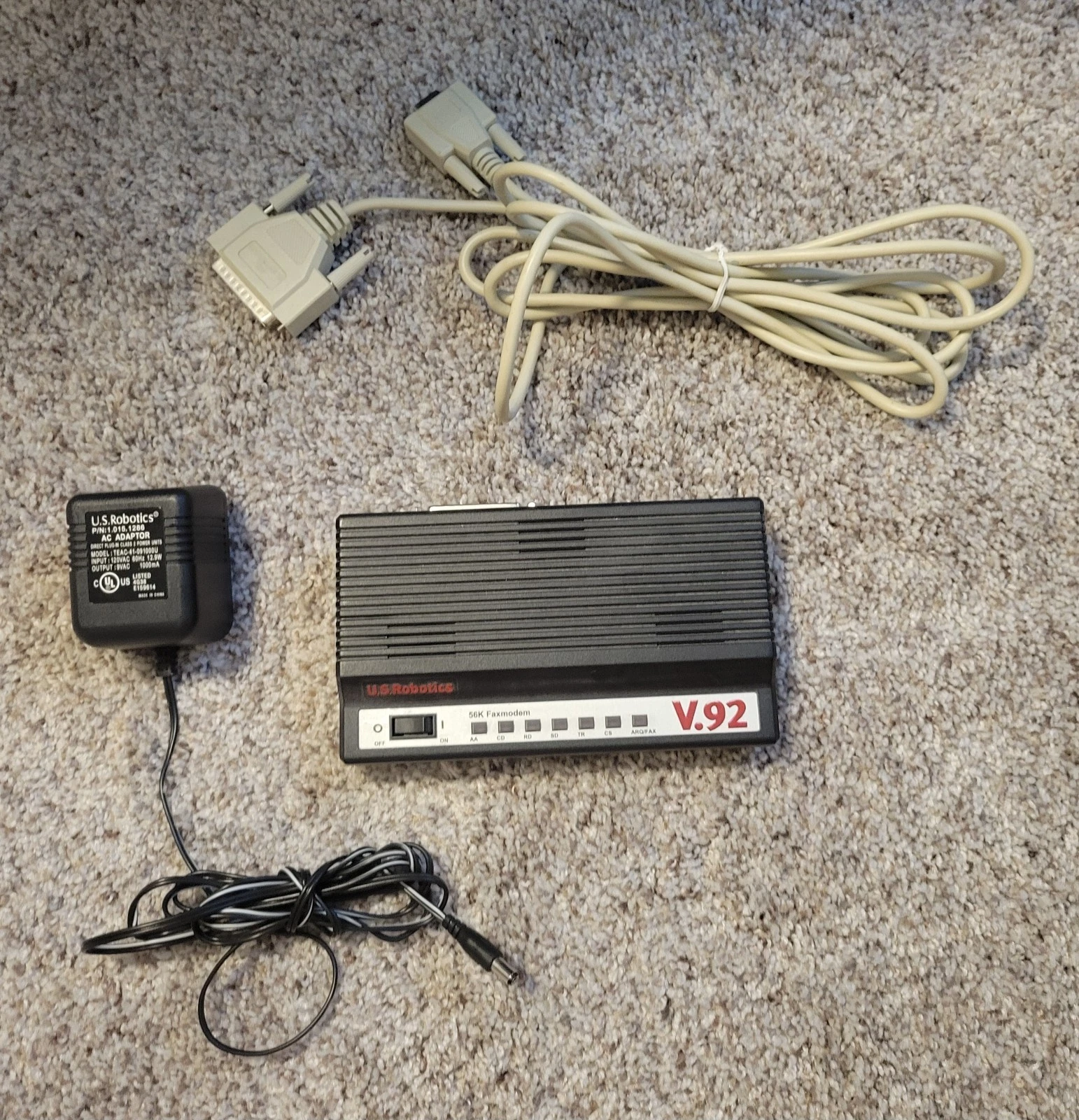
A modem is literally a modulator and demodulator: it converts discrete data into a continuous electrical signal that can pass through the voice channel of the telephone network, while the receiver estimates the original symbols. It does not simply "play zeroes and ones"; it controls the carrier's amplitude, frequency and phase in the presence of noise, echo and distortion.
01 / Transmission channel
The subscriber loop is two-wire and was originally optimized for speech. Telephone exchanges therefore suppress very low and high frequencies. In the digital part of the network, speech is typically sampled 8000 times per second; by the Nyquist criterion this creates a theoretical limit of 4 kHz, but practical filters leave a band of roughly 300 to 3400 Hz.
Along the way, the signal suffers from frequency-dependent attenuation, group delay, impulse and thermal noise, crosstalk, PCM quantization distortion, and echo at the transition between two-wire and four-wire circuits. The result is intersymbol interference: the response of one symbol extends into the decision instant of the next.
02 / Modulation
Bits are grouped into symbols. Each symbol corresponds to a certain carrier state. In binary FSK, one symbol carries one bit; 16-QAM has sixteen states and ideally carries four bits per symbol.
Baud is the number of symbols per second, while bit/s measures information rate. Ignoring overhead, Rb = Rs · log2(M).
s(t) = I(t) cos(2πfct)
− Q(t) sin(2πfct)
Functions I(t) and Q(t) are orthogonal components formed from the symbols and the pulse-shaping waveform. The receiver obtains them by correlating the signal with synchronized cosine and sine waves. It plots the result as a point in the constellation plane and decides which ideal state is nearest.
Interactive oscilloscope
The simulation is local and schematic. Noise changes the variance of received points; nothing is sent or connected to the telephone network.
03 / Demodulation
Demodulation is not simple carrier subtraction. Automatic gain control first stabilizes the level. The carrier and symbol clock recovery loops look for the correct frequency, phase and decision moment. A matched filter maximizes the signal-to-noise ratio and an adaptive equalizer approximately inverts the line's frequency response.
Duplex modems also cancel their own echo: they know the symbols they are transmitting, model their return through the hybrid and subtract it from the received signal. The decision device then selects the nearest constellation point. A trellis decoder can use the Viterbi algorithm to find the most likely sequence of states, while V.42 adds error detection and frame retransmission above the physical layer.
04 / Physical limit
The denser the constellation, the smaller the distance between neighboring states and the easier it is for noise to confuse them. Shannon capacity of an ideal channel C = B · log2(1 + S/N)
says that the achievable data rate is limited jointly by bandwidth B and the linear signal-to-noise ratio S/N. The decibel conversion is
S/N = 10SNRdB/10.
05 / Assembling the connection
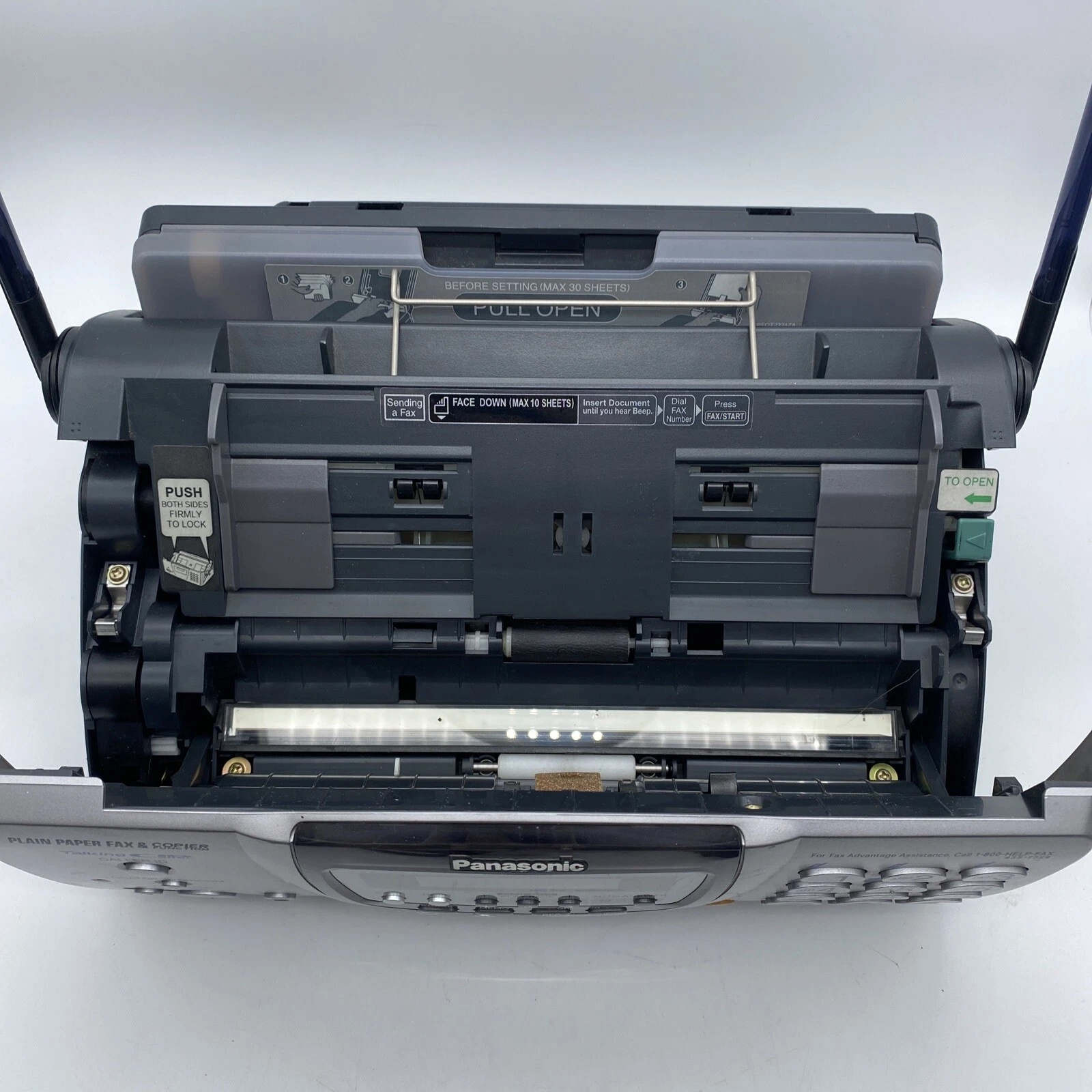
06 / Fax transmission
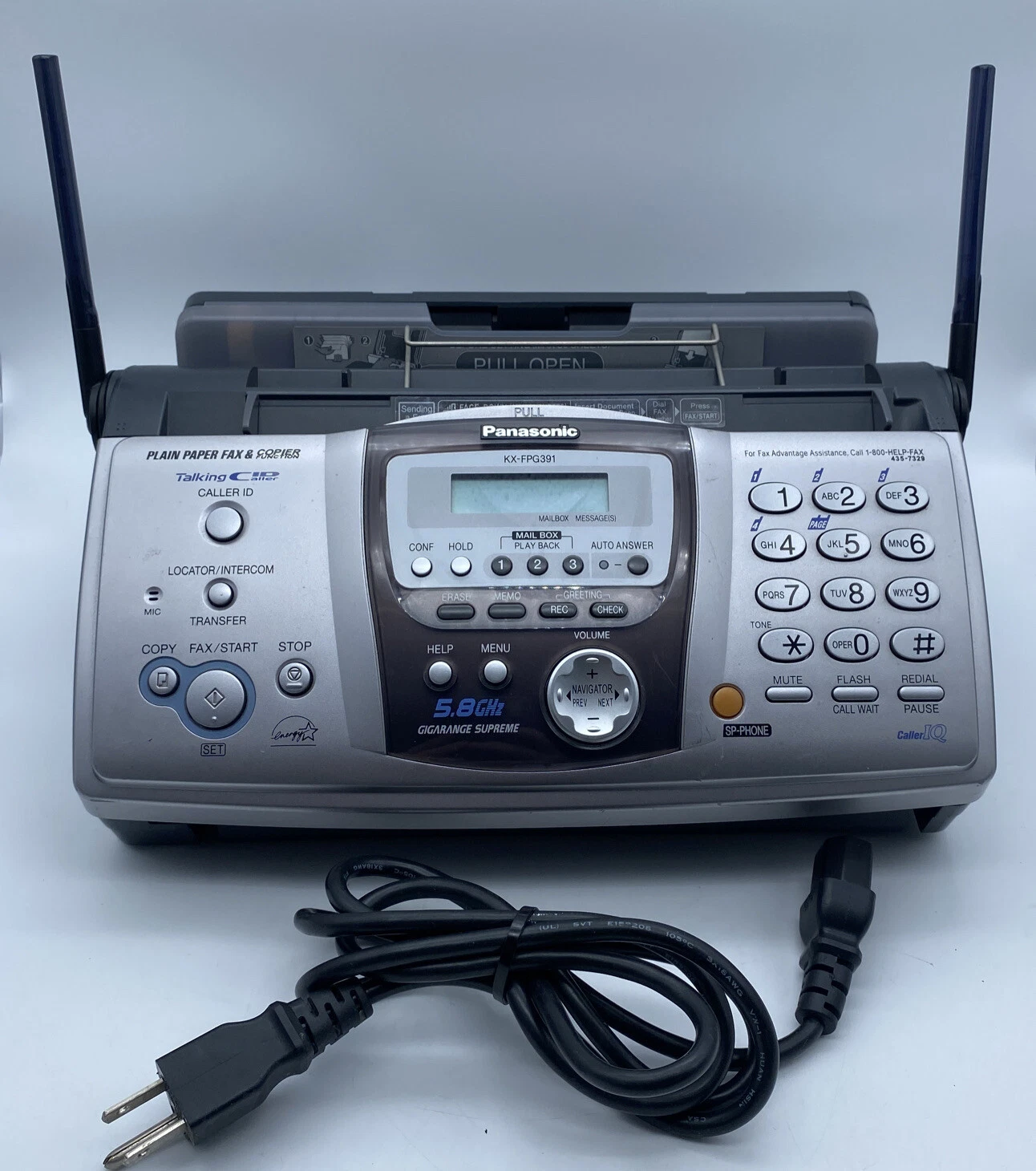
A calling automatic fax sends CNG at 1100 Hz: 0.5 seconds of tone followed by 3 seconds of silence, both with ±15% tolerance. This announces: "I am not a person; I want to send a fax." By contrast, a regular data modem using V.8 waits for the answering ANSam at 2100 Hz and then sends a digitally coded capabilities menu.
One important qualification: the answering fax sends CED at 2100 Hz as well (±15 Hz, 2.6 to 4.0 s continuously). Modem ANSam has a tighter tolerance of ±1 Hz, amplitude modulation of 15 Hz, and typically reverses phase every 450 ms. So the devices don't differentiate the service just by a single frequency, but by direction, cadence, modulation and following protocol.
After the tones, the fax enters the T.30 control phase: HDLC frames run at 300 bit/s over FSK V.21 channel 2. Frequency 1850 Hz means binary 0 and 1650 Hz binary 1. Receiver sends DIS with capabilities, transmitter replies DCS with selected mode, followed by training, TCF and CFR confirmation. Only then is the page transmitted using the faster V.27 ter, V.29 or V.17 modulation; V.17 uses 2400 Bd QAM, adaptive equalization and trellis coding up to 14.4 kbit/s.
The volume is intentionally low. The sound will start only when pressed.
Ready to listen.
Synthetic museum reconstructions according to ITU-T V.8, V.34, V.21, T.30 and V.17. They preserve the character and sequence of phases, they are not a bit-accurate recording of a specific device.
Ready: dialing a number and setting up a call by phone.
Ready: number dialling and the fax calling tone.
Numerical parameters are based on ITU-T recommendations:
Security wing
The Internet was not designed to be a public square for billions of people. With its growth, therefore, new attacks and defense layers were created. This exhibit traces one important branch of the broader history of the Internet.
Static pages, FTP passwords, shared accounts and minimal automatic updates.
An attachment from a known person didn't seem suspicious yet. That quickly changed.
Blaster, Slammer and similar incidents have shown how quickly the Internet contagion spreads.
Attacks are no longer just technical. They started copying banks, services and work communication.
Certificates became cheaper, automated, and encryption became the expected standard.
Strong identity, multi-factor, isolation, monitoring, CSP, HSTS, DNSSEC and secure development.
Security Wing Laboratory
Try typing the password. The sample only calculates orientation resistance according to the length and variety of characters, it does not send anything anywhere.
Enter the password and the museum will estimate its condition.
Enter a URL and see which signals a person should check before clicking.
Choose a script and see which headers give the browser modern controls.
Internet today
Today's Internet is a mixture of optical paths, mobile networks, data centers, open protocols and security mechanisms. The user does not see most of this infrastructure, yet uses it almost constantly.
Today, home lines carry more data per second than entire academic backbones of the past. The bottleneck is usually no longer the telephone voice channel.
Data networks moved the Internet from the desk to the pocket. Connection is no longer a special mode of the computer, but a permanent state of the phone.
The service does not have to live on one server or in one country. Compute, storage and copies of content are spread across data centers close to users.
The name system translates names into addresses, DNSSEC allows you to verify the response, and HTTPS protects the traffic between the client and the service.
Video, voice, gaming and live streaming require low latency, buffers and protocols that can adapt to the quality of the connection.
The new address space responds to billions of connected devices. In addition to computers and phones, there are online sensors, cars, televisions and industrial systems.